 OfflineStatement
PDF to QFX for Quicken
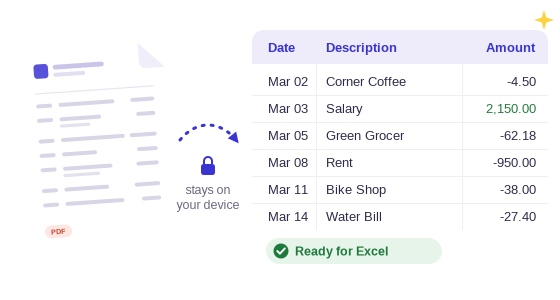
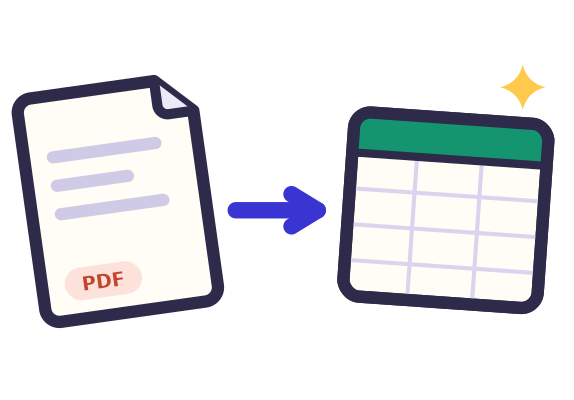
Quicken imports .qfx files, not PDFs. Drop your bank or credit card statement here and download a .qfx file with dates, amounts, payees and the closing balance. The PDF is read on your device and never uploaded.
 Drop statement PDFs hereor click to choose filesTap to choose a statement PDF
Free: 3 statements a day, no sign-up.
Bank not supported yet? Email the bank name and country to [email protected] and we'll add it. No need to send your statement.
How your statement stays private
- Your PDFPick a statement from your computer or phone.
- Read in this tabThis page reads it on your device and never sends the file anywhere. Turn off your wifi after the page loads and it still works.
- Your spreadsheetThe rows go straight into a file in your downloads.
Works with most banks
Reads text-based PDF statements with debit/credit or single-amount columns, in US, UK, European, Indian and Indonesian number formats. Password-protected e-statements work too, and the password stays on your device.
Checked, not guessed
Every statement gets a running-balance check: if a row doesn't add up to the printed balance, we highlight it, so nothing goes into your books wrong.
Hours of typing, done in a minute
Free: preview every transaction and download the first 25 as a CSV.
Pro: every transaction, a year of statements in one file, Excel, QuickBooks (.qbo and CSV), Quicken, Xero and OFX. See pricing
Import it into Quicken for Windows
- Drop your statement PDF in the box above. Check the preview: the running-balance check tells you whether every row was read right.
- Choose Quicken .qfx (a Pro format). The file lands in your downloads.
- In Quicken, go to File > File Import > Web Connect (.QFX) File and pick the file.
- When Quicken asks where the transactions go, choose Link to an existing account and pick your account, or create a new one. Then accept the downloaded transactions in the register.
Quicken for Mac
Use File > Import > Bank or Brokerage File (OFX, QFX), pick the .qfx file and choose the account to import into.
What's inside the file
A .qfx file is an OFX bank file plus Intuit's bank id field, which Quicken checks before it imports. Each transaction carries its date, its signed amount (money out is negative), the payee and the full description as a memo. Card statements go in as a credit card account, with charges as negative amounts. When the statement prints a running balance, the last one becomes the statement balance. Each transaction gets a fixed id, so importing the same statement twice doesn't create duplicates.
A year of statements? Drop all the PDFs together: Pro merges them into one .qfx file and drops transactions that appear in two overlapping statements. Using QuickBooks too? The same transactions come out as a .qbo file for QuickBooks.
FAQ
Why won't Quicken import my CSV or OFX file?
Quicken for Windows imports Web Connect files (.qfx), which carry Intuit's bank id. A CSV or a plain OFX file usually doesn't have one. Choose Quicken .qfx here instead.
Does it work for credit card statements?
Yes. The file opens as a credit card account: charges come out as negative amounts and payments as positive ones.
Can it read scanned statements?
No. It reads statements with real text in them, which is what banks send as downloads. A scanned or photographed page has no text to read.
Is my statement uploaded?
No. The PDF is read by code running in your browser and the .qfx file is made there too.